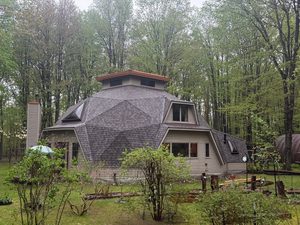
We were up on a lakefront roof recently, standing right where two rooflines meet in a valley, with fresh pipe boot flashing and step flashing still exposed before the final shingle work covered it. From the ground, nobody will ever see that detail again once the job’s done. But it’s the single spot on that roof most likely to determine whether it leaks in year three or holds up for the next 25 years.
Homeowners tend to blame shingles when a roof leaks. Realistically, the shingles are rarely the actual cause. Here’s why valleys and flashing details matter more than almost anything else on a roof, and what separates a valley that holds up from one that doesn’t.
Why Valleys Take More Abuse Than Any Other Part of the Roof
A roof valley is where two roof planes meet at an angle, and that geometry means every drop of water from both sides funnels through that one line. On a simple gable roof there might be one or two valleys. On a complex roofline — the kind with multiple gables and dormers, like a lot of the lakefront and custom homes we work on — there can be four, five, sometimes more, each one carrying a disproportionate amount of water compared to a flat section of roof.
On a lake property specifically, that problem compounds. Wind-driven rain off the water and heavier lake-effect snow both concentrate more water volume through valleys than a typical inland roof sees, which is exactly why we treat valley work differently on waterfront homes than we would on a standard neighborhood re-roof.
What Actually Goes Into a Valley Done Right
Ice and water shield first, always.
Before any shingle or metal touches a valley, a self-adhering ice and water membrane goes down the full length of it — this is the layer that actually stops water if anything above it ever fails. Skipping or skimping on this step is one of the most common shortcuts we see on roofs that come to us with leak problems.
Choosing the right valley method.
There are a few ways to build a valley open metal valley, closed-cut shingle valley, or woven valley — and which one’s right depends on the roof pitch, the shingle type, and honestly, the climate. In a region that sees real winter, we lean toward open metal valleys more often than a lot of installers do, because metal handles ice and heavy water flow better than shingle-on-shingle methods.
Step flashing at every wall or dormer intersection.
Anywhere a roof valley runs into a sidewall, chimney, or dormer, step flashing has to be layered correctly — each piece overlapping the one below it, tucked under the siding or counter-flashing above. Get this wrong and water works its way sideways into the wall assembly instead of running down the roof, which is a much harder leak to trace later.
Pipe boot flashing near valleys.
When a vent pipe happens to sit close to a valley — like the one you can see in the photo above — the flashing around it has to account for the extra water volume moving past it. A standard pipe boot placed without factoring in valley runoff is a common spot for slow leaks that don’t show up for a year or two.
Proper shingle cutting and exposure at the valley line.
On a closed or cut valley, shingles need to be trimmed cleanly and consistently along the centerline, with the right amount of exposure so water sheds instead of catching on a rough edge. A rushed cut here looks fine from a distance and fails early up close.
Why This Matters More on a Complex or Lakefront Roof
A simple roof with one or two valleys has less room for error simply because there’s less valley to get wrong. A roofline like the one we were working on — multiple gables, several valleys converging, a chimney chase in the mix — multiplies the number of places a mistake can hide. Add lakefront wind and snow exposure on top of that, and valley work stops being a minor line item and becomes one of the most important parts of the whole project.
Signs a Valley Might Already Be Failing
If you’re dealing with a leak or just want to check an existing roof before it becomes one, a few signs point specifically to valley or flashing problems rather than general shingle wear:
- Water stains inside the house that trace back to a spot below a valley, not a flat roof section
- Visible granule loss or bare spots concentrated along a valley line
- Rust streaking on metal valley flashing, which usually means the coating has worn through
- Shingles lifting or curling right at the valley edge, even if the rest of the roof looks fine
- A leak that only shows up during heavy rain or fast snowmelt, not light rain — a strong sign it’s a volume problem specific to a valley
What to Ask If You Suspect a Valley Problem
Not every roofer inspects a leak by actually getting up and checking the valley closely — some default to assuming it’s a shingle issue and re-shingling over the same flashing mistake. Ask specifically whether the inspection includes lifting shingles near valleys to check the flashing underneath, not just a visual pass from the ground or a ladder. If a previous roof was installed with woven or closed-cut valleys and keeps leaking, ask whether converting to open metal valleys makes sense for your specific roof and climate.
8. FAQ SECTION
Why do roof leaks usually start at valleys instead of the flat parts of the roof?
Valleys collect and funnel water from two roof planes at once, so they handle far more water volume than any flat section. Combined with the added complexity of flashing where materials and roof planes meet, valleys are statistically the most common failure point on a roof.
What’s the difference between open and closed valley flashing?
An open valley uses a metal channel running down the seam with shingles trimmed back on either side, while a closed or woven valley uses overlapping shingles with no exposed metal. Open metal valleys generally handle heavy water and ice better, which matters more in colder climates.
Can a roof leak be fixed without replacing the whole roof?
Often, yes — if the leak is isolated to a valley or flashing issue, targeted repair is usually possible. That requires an inspection that actually checks the flashing underneath the shingles, not just a surface-level look.
How often should roof valleys be inspected?
An annual visual check is reasonable for most homes, but after any major storm, ice buildup, or if you notice interior water stains, a valley-specific inspection is worth scheduling sooner rather than later.
The Bottom Line
Shingles get the credit for how a roof looks, but valleys quietly do most of the work of keeping water out — and they’re also where the vast majority of leaks actually originate. A roof with a strong valley system, correct flashing, and the right method for the climate is one that holds up through decades of Michigan winters and lake-effect storms instead of surprising you with a stain on the ceiling a few years in.
If you’re dealing with a leak, or planning a roof replacement on a home with a complex roofline, we’re glad to get up there and take a real look at the valleys before assuming it’s anything else.